Maya Research
Voice AI for the next five billion.
maya research
Who we are
The team

We come from the five billion, and we're obsessed with building for them.

Maya founders
Dheemanth Reddy 𝕏
Co-founder & CEO
Bharath Kumar 𝕏
Co-founder & CTO
Founders from
NYU Courant Institute
Backed by South Park Commons
maya research
The opportunity
The fundamental shift

Voice is becoming the universal operating system for everything.

One way to run every device, machine, and workplace — just by talking to it.
01

Personal Devices

  • Smartphones
  • Laptops
  • Smart glasses
  • Earbuds
  • Wearables
02

Humanoids & Robots

  • Humanoid robots
  • Home robots
  • Service & delivery bots
  • Companions
03

Home AI

  • Home assistants
  • Smart appliances
  • Ambient home OS
04

Enterprise Workflows

  • Call centers
  • Field agents
  • Retail staff
  • Sales teams
  • Support teams

Independent evaluations place Maya at the voice frontier.

Maya 2 Native leads the Voice of India human-evaluation board.
Scroll inside ↕
maya research
Open-source adoption

Open weights put Maya in more people’s stacks.

Veena and Maya 1 let developers download, fine-tune, and ship Maya models before the API. Maya 1 is also a top-10 open-weight TTS model worldwide.

maya research
Model economics
Model economics

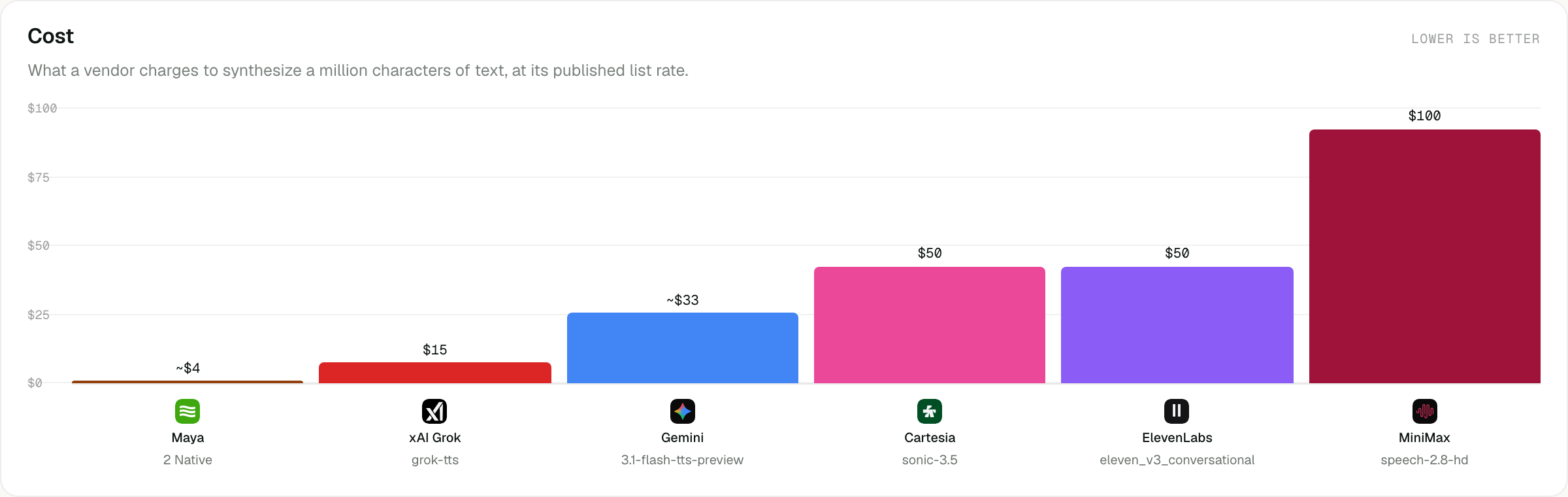
Maya holds its own against Gemini, ElevenLabs and Cartesia at a fraction of the cost.

Speko cost benchmark: Maya 2 Native at approximately four dollars per one million characters, compared with xAI Grok at fifteen dollars, Gemini at approximately thirty-three dollars, Cartesia and ElevenLabs at fifty dollars, and MiniMax at one hundred dollars.
Sources: Speko multilingual Hindi benchmark ↗  ·  Speko TTS board ↗. Cost reflects Maya’s quoted price, which Speko notes has no public rate card.
maya research
Model latency
Time to first audio

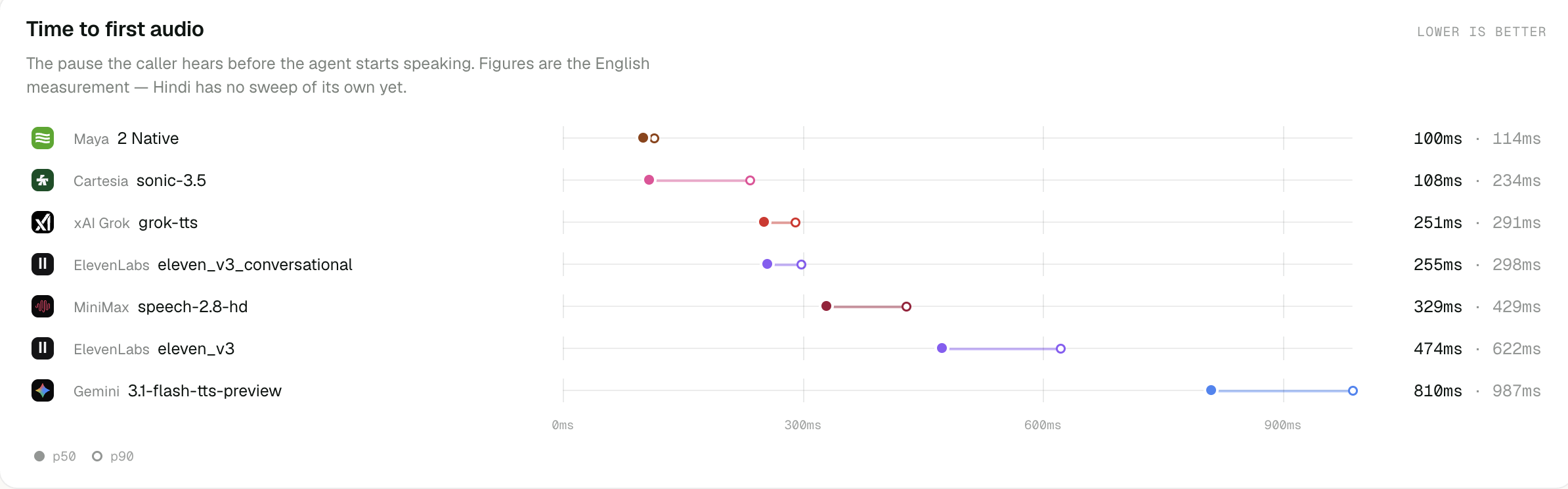
First audio in ~100 ms.

Time to first audio benchmark. Maya 2 Native measures 100 milliseconds at p50 and 114 milliseconds at p90, ahead of Cartesia, xAI Grok, ElevenLabs, MiniMax, and Gemini.
maya research
Hear it for yourself

Native vs Alien

Listen to Maya 2: Our most native voice model yet
Our model

Maya 2 Native

0:00
 

Cartesia Sonic

0:00
 

Sarvam Saaras v3

0:00
A fraction of the big labs' budgets, and already outpacing them on quality.
maya research
The technology
The Architecture

We applied the DeepSeek playbook to native voice.

The whole stack is engineered to be cheap to train and cheap to serve. Three ideas do most of the work.
01 · Architecture

HARP

Hybrid attention + Parallel decoding. One checkpoint: block-diffusion + self-speculative, with SSM routing that keeps long turns linear-cost. Quantized, single GPU.

02 · Backbone + data

Continual Pre-Training

We take full leverage of frontier text models — A Strong Text based backbone that already reasons across languages — and continually pre-train it on trillions tokens of audio we own at source.

03 · The data flywheel

Data Advantage

Our consumer app is a data engine — every conversation feeds proprietary, accented speech back into training. Large teacher models add unlimited synthetic data. No one else has this loop.

The result: The most native speech model, which is at frontier quality and a fraction of the cost
maya research
Go-to-market
Go-to-market

One model, every high-volume voice workflow.

Where it can land
BFSICommerceHealthcareTelecomTravelPublic services
Enterprise verticals: NextMSC ↗
01
BFSI
“My card was declined.”
Cards, loans, insurance · regulated and multilingual.
02
Customer support
“Where is my order?”
Commerce, telecom, travel · high-frequency repeat contact.
03
Sales
“Which plan is right for me?”
Financial products, retail, healthcare · conversion-led.
04
Collections
“Can I pay on Friday?”
Lenders, insurers, utilities · payment-sensitive and outcome-linked.
05
Enquiries
“Am I eligible?”
Public services, education, healthcare · wide reach and first touch.
maya research
Market scale
The five-billion market

Voice AI for the next five billion.

The expansion path
5B
people at the frontier of the next voice interface.
India · launch market
Southeast Asia · multilingual growth
MENA · Arabic-first interfaces
Africa · local-language access
Latin America · voice-native service
maya research
Enterprise adoption

Maya already runs across enterprise, vertical agents, and inference partners.

A direct collections deployment, two vertical-agent platforms, and three inference partners.

01
Enterprise
Direct deployment
Collections workflows on Maya models.
02
Vertical agents
Maya in production
Enterprise pipeline
Active conversationswith additional enterprises across BFSI, customer support, sales, collections, and enquiries.
maya research
Usage traction

Enterprise usage is accelerating.

+66%
Enterprise API usage
grew week on week.

Maya is becoming the default voice interface for the next 5 billion.

1 / 21
The data

What's actually inside 34 million conversations.

How we collect it
Every conversation inside the Maya app — consumer and enterprise — opted-in, real usage, not scripted studio recordings. No paid data-labeling vendors.
What kind of data
Full-duplex audio, transcripts, prosody, accent, and code-switching context — across Hindi, Telugu, Bengali and 20+ more languages.
Quality
Real accented speech from real people, not synthetic TTS loops. Filtered and deduplicated — the exact distribution our models are judged on.
How it helps the models
Feeds continual pre-training and the data flywheel directly — every new conversation makes the next model more native.
Other nuances
Large teacher models add unlimited synthetic augmentation on top of this — but the real accented core is what no one else has.
Organic content on YT
People are already using Maya on their own and making how-to videos about it — see the organic content on YouTube ↗.
The next five billion

Maya is becoming the default voice interface for the next 5 billion.

A world of languages

The next five billion speak 7,159 living languages.

A glimpse of the world's living languages · green = the handful today's AI serves · the rest are the next five billion. In India alone: 1,369 mother tongues, 121 major languages — 22 with any institutional support.
Quality per dollar

Best model anyone can compete with — on 1/100th the capital.

VoiceArena Hindi score
Leaner · less capital raised →
1086
1072
1058
1044
$10B
$1B
$100M
$10M
The cracked corner
Maya$1.9M
Smallest$8M
ElevenLabs$781M
Cartesia$191M
Sarvam$275M
MiniMax≈$1.77B
xAI≈$42B+
Maya delivers frontier voice quality on a fraction of the capital. Every rival raised more—some by four orders of magnitude. Quality: VoiceArena Hindi (Bradley-Terry Elo). Total disclosed capital through 4 Jul 2026: Maya $1.9M · Smallest $8M · Cartesia $191M · Sarvam $275M · ElevenLabs $781M · MiniMax ≈$1.77B incl. IPO · xAI ≈$42B+ incl. debt.
Why it doesn't split focus

Enterprise is the same model — turned on, not built.

No new build
Same weights, same training loop that already powers the consumer app. Enterprise is a revenue tap, not a second product — zero diverted engineering.
Demand already exists
500K downloads of the open weights — inbound from conglomerates and startups, already hosted on AWS, Cloudflare, FAL and Baseten. Nothing to cold-start.
Why sequence it
We turn on the paid API once the model matures — so it funds the consumer mission instead of forcing another dilutive raise.
Focus stays consumer
One team, one asset, one focus. Enterprise revenue rides on top of the flywheel — it strengthens the consumer bet, doesn't compete with it.
Open-weight leaderboard

Maya‑1, our open-weight model — released 13 months ago, still top 5.